Tuesday, 25 June 2013

INQUIRY: THE HUMAN BODY

1 comments
Our Inquiry on the Human Body has been an amazing experience!  

Here are some photos of student work in  the Discovery Books:


Evidence of Learning! on PhotoPeach

Monday, 24 June 2013

INQUIRY- THE HUMAN BODY

0 comments
Our Human Body inquiry began with the children working in groups to write down their "wonderings" about our bodies and how they work.  The children had many different wonderings including- what is our brain made of?  Is our heart shaped like a heart?  How does the brain send messages?  What is the skeleton?  Why is your pee yellow?  How do the lungs work?  What is your body made out of? etc...  

Afterwards, we looked at our wonderings and I asked the children how they thought we could set up learning stations in our room. Our "Learning Stations" are inquiry-based stations that have been put together by myself and students based on their "wonderings."  After many ideas, we decided that we would create four learning stations: Heart and Lungs,  The Skeleton,  The Senses, The Brain and Spine.  I gathered as many books as I could find on each of these areas and searched the internet for sites and videos that helped to teach the children about them.  I also looked specifically for sites and videos that helped to answer their inquiries/wonderings about each area.  At each station there were books, posters, QR Codes with links to videos and the list of "wonderings" from the class.

I was amazed (yet again!) at how well my students worked through the stations.  They all had the opportunity to visit the stations and were also encouraged to stay at a station if they needed to continue exploring an idea.  The results were incredible!!  Children were reading together.  Children were sharing information.  Children were sharing their "wonderings" which then led to other "wonderings."  Some students showed their learning just with a picture and labels, some only wrote things down and some did both.  

Here are the four inquiry stations:  
The Senses Inquiry Station

The Skeleton Inquiry Station


The Brain and Spine Inquiry Station

The Heart and Lungs Inquiry Station

One thing I loved with this inquiry on the human body, was that all of the activities came from the children researching and finding activities to do.  For instance, during the first visit to the Heart and Lungs Station, a child started running and had a friend listening to her heartbeat.  This then prompted the student to use paper towel tube to listen to the heart.  This same student also brought in the lung and heart model from her mother's school to share with us.  This discovery led to more friends experimenting with the heart and the beats (I wonder if it beats more when we sit?  Or is it less?).  At the Senses station, the children found activities to do to test their senses.  I could have put out the jars and listed activities (and yes you know which ones...) but instead the owness was on them.  I encouraged the children to think of some activities to try and that together we would find the items they needed to do them.  Students marked their activities found in books with a sticky note.  Some groups did an experiment they found with hot, warm and cold water.  Others made textured art using different things and described the materials.  Another group played the game where they hid different items under a cloth and their friend had to feel each item and guess.  At the Brain and Spine station, students were holding their breath to see how long they could last before their brain sent a message to force them to breathe.  It really was amazing to watch the children research on their own, try different activities,  discover new ideas and then share their findings with one another.  They were excited to share and couldn't wait to get to their stations each day!

Here are some clips of the discoveries taking place...


What does is it?  What does it feel like?


I can see your tastebuds!


Tricking my brain by putting my finger in cold and hot water, then into warm!

This pulls the lung down to fill with air!


Sunday, 9 June 2013

CAPTURING SPRING!

0 comments
In April, the children were given the opportunity to capture images of  Spring using the camera on an ipad.  Spring had just started.  Afterwards, the children chose one spring photo to paint.  They worked hard painting their Spring Image and the classroom display for Education Week was so pretty!  This is an activity I absolutely loved doing and I hope to do something similar next year with all of the seasons!


Spring Photo Art on PhotoPeach

Friday, 7 June 2013

LIVING THING INQUIRY CONTINUED...

0 comments
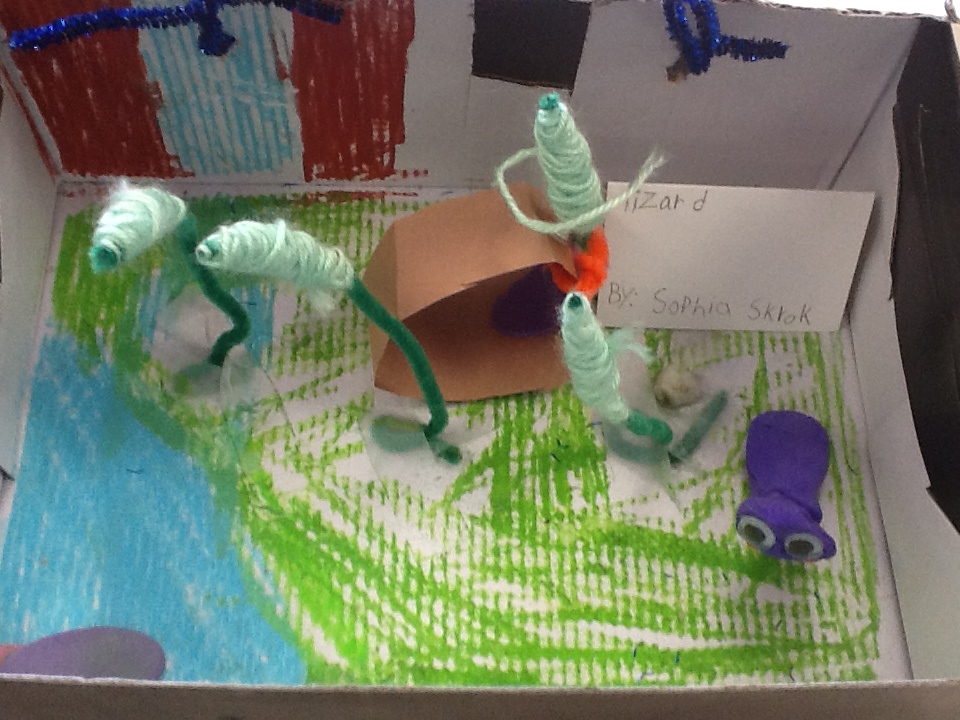
As the children finished their inquiry into chicks, butterflies, plants and hermit crabs they decided to further investigate an animal of their choice.  I replaced our "Living Things stations" with animal and plant books.  Students had an opportunity to go through the books and decide on a animal they wish to explore further.  Each student created their own "Wondering" on paper about an animal.  I went to the library and signed out as many books as I could about the animals they had chosen.  The books were then placed into our "Research Station."

For the next two weeks the students researched their animal at school using the books and went to the "Creation Station" to make their animal.  They had decided previously that they wanted to make their animal and one boy had suggested that they also make their own habitat.  The children had access to every recycled item and material I could find.  Most decided to make their animal using clay and they thought of creative ways to make/represent the animal's habitat.

Afterwards, each student shared their animal and habitat with the class.  They orally reported what they had wondered about their animal and the information they had learned by researching it. Take a look at these photos that show their creativity and discoveries...
Tigers
"Tigers need a lot of food to live.  They can climb high.  They jump up to 3.  They need a lot of water.
 I wanted to have a family of tigers."
Tiger
"They always hunt for wild animals that are littler and with meat.  They are really quiet, smell it
walk to it.  They only bite it's head or neck.  It makes it die.  If they bite the legs they wouldn't die.
They have night vision."

Whales
"I learned that whales only east some jellyfish when they are small because their mouths can't go wide
like hippos.  Barnacles are animals on a whale, little bumps and it doesn't come off."
Turtle
"I learned that turtles lay their eggs on land.  They don't have teeth but a hard  beak.  Sea turtles can't put
their head into their shell.  The first (legs) ones does the paddling and the back ones (legs) steer.   Lights and buildings hurt the turtle.  They follow the moon when hatched and go to the sea.  But they get tricked by lights on a building and go to the building."
Boxer Dogs
"I learned that boxers are active.  (What does that mean?)  it lot's of stuff and they never stop til they are done it.  They love to play fetch.  They don't want to stop until they do.  They like to eat, play fetch and run a lot.  A lot of times they run upstairs and jump on beds and they like to cuddle with you."
Parrot
"I learned that parrots need food and water to live.  Well, parrots don't talk but trained parrots learn to talk.  They are the only animals in the whole world that can talk.

Turtle
"I found out that sea turtles eat jelly fish and that the not sea turtles (land turtles) live on land and water.  They go inside their shells to be protected.  Turtles are attached to their shells.  Their shells grow with them.  The shell peels a little bit.  The shell cannot come off without the turtle dying."
Kangaroo
"I discovered that kangaroos like to go in hot places and they like small places.  They like a lot of water.  They can hold their joey in the pouch.  A joey is a baby kangaroo.  The joey comes out when it is old enough to survive by itself."
Lizard
"I learned that some types of lizards don't have any legs or arms and are like snakes.  They slither along.  They live in the jungle.  There are a lot of types of lizards."
Chick
"I researched that the yolk comes from the hen.  It goes down a tube and it makes the yellow in the egg.  Chicks use their egg tooth to peck themselves out of the egg."
Tiger
"Tigers fangs are as tall as a diet coke or coke can.  They can kill animals bigger than themselves.  They are the only cats that like water."
Shark
"I learned that sharks eat fish and other things.  Sharks usually lose one tooth every time it eats."

Monday, 27 May 2013

LIVING THINGS INQUIRY!

0 comments
To begin our Living Things Inquiry, students watched a BEAUTIFUL video Characteristics of Living Things  that showed our incredible earth and some amazing life.  As the children watched they responded to the images on the screen with wonder and excitement.  They were excited to begin discussing their wonderings about different animals and living things...  and there were many, many, many wonderings!  So many in fact... the inquiry has just kept growing and we are now into week four!

I found that the best way to honour these inquiries was to "chunk" some of it.  First, I asked the class what living things were in our room.  At the time, we had eggs in our incubator, bean plants growing (from our Energy inquiry), our 2 hermit crabs and caterpillars.  I asked "Is there a way to investigate living things by using the living things in our classroom?"  Many of the students suggested we use stations again.  The class and I decided to have "Living Stations."  They suggested a chick station, a plant station, a hermit crab station, a butterfly station, a creation station, a research station (for our other wonderings) and a people station (as we are living).  At first I thought, okay it is a lot to focus on, but we can do it... but after a day of really considering the stations, I decided to suggest to the students that we focus only on our first four stations as there was going to be a lot of changes to some of our living visitors.  We then decided that we would focus on these four stations:  the chick station, the plant station, the hermit crab station and the butterfly station.  Afterwards, we would continue our research into our wonderings and look more in depth into people and the human body.

Once again, I asked the students to choose one area they would like to study in-depth about.  Each group then got together and began to write their wonderings about that living thing.  Here are the wonderings:
Wonderings about Caterpillars & Butterflies
Wonderings about Chicks

Wonderings about Hermit Crabs
Wonderings about Plants
After gathering materials to help students explore and discover what living things are and what they need (i.e. library books, life cycle posters) we co-constructed a list of  "I can..." statements and questions they could explore at each station.  After examining, the wonderings I also spent time searching for interesting videos on youtube and created QR codes (and for those who know me... this was a pretty big step in my growth with technology!) for each station.

With much excitement, the students traveled in their groups to each station for 2 large chunks of time (they were also free to go their during other points in the day) to explore their wonderings about the living things, discover new ideas and share their learning with one another through discussion and their "Discovery Book" work.  The results were AMAZING!  The children were so engaged that at one point they had been at one station for over 30 minutes and they were still focused!  (I even took a video of it to show my colleagues, my principal and the children in the class!)

 Here are photos of each Living Inquiry Station:
The Chick Station:  The Incubator
The Chick Station: Brooder
The Hermit Crab Station
The Butterfly Station: The Caterpillars
The Butterfly Station:  Butterfly Cage
The Plant Station
 Here are some photos that capture the children exploring, discovering and documenting their learning:


Here are some samples of work:
Hermit Crab Habitat and Observations
Discovery:  A Hermit Crab is moving into another shell
Discovery:  Picture of a Hermit Crab changing shells
Discovery:  Hermit Crabs shed their skin.
Hermit Crab Observation
Hermit Crab Habitat: Labeled needs
Hermit Crab Habitat and Needs
Plant Observation:  Seeds are different
Discovery from video:  This plant can eat bugs.
Planting Inquiry:  Planting a flower in a box with just a hole
Discovery from video:  I learned how some plants can eat insects
Observations & Discovery:  Caterpillars
Observations:  The butterflies grow a chrysalis.
Picture of caterpillars hanging and food.
Observations of Caterpillars
Discovery from video and books:  Butterfly Life Cycle
Discovery of how the chick grows & picture of what is inside the egg (observation)
Observation of incubator and response to a video that showed the chick growing inside the egg.
Observations of the incubator and chicks hatching
Observation of the incubator & what the embryo looks like inside the egg
Discovery: Response to video on the life cycle
"I learned that they are growing in the egg.  The chicks use their beak to get out."
Observation of what is happening inside the egg when we "light" them
Discovery:  Life Cycle of the Chick


Wonder, Explore & Discover in Grade One Copyright © 2012 Design by Ipietoon Blogger Template